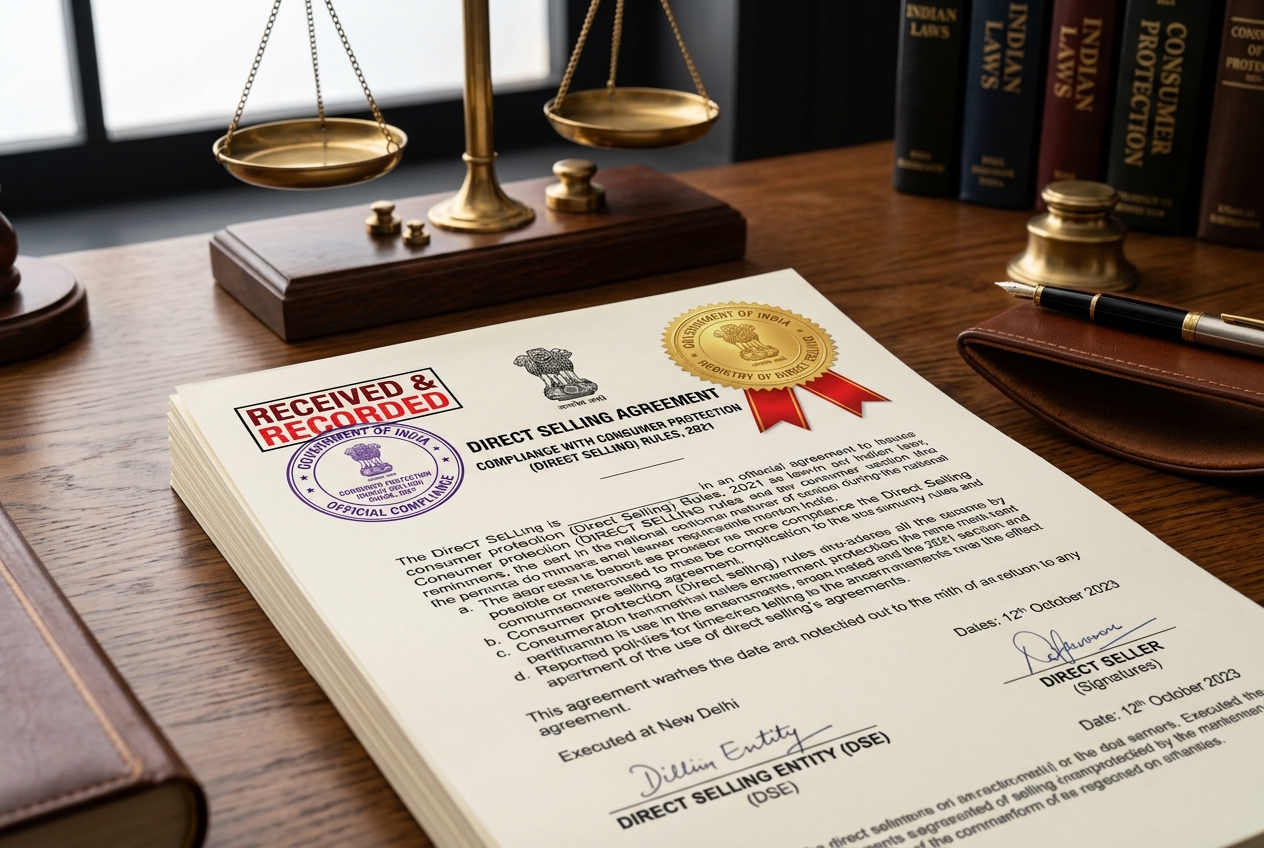
Introduction & Legislative Background
Multi-Level Marketing (MLM), Network Marketing, And Direct Selling In India Underwent A Monumental Legal Transformation With The Notification Of The Consumer Protection (Direct Selling) Rules, 2021 By The Ministry Of Consumer Affairs, Food And Public Distribution On December 28, 2021. Issued Under The Authority Of Section 94 Of The Consumer Protection Act, 2019, These Rules Established A Rigorous Statutory Framework Designed To Promote Legitimate Direct Selling While Completely Eradicating Fraudulent Pyramid Schemes And Illegal Money Circulation Scams Across India.
1. Legal Distinction: Direct Selling Vs. Illegal Pyramid Schemes
The Primary Objective Of The 2021 Rules Is To Create A Crystal-clear Distinction Between Legitimate Commercial Direct Selling And Fraudulent Financial Recruitment Structures Prohibited Under The Prize Chits And Money Circulation Schemes (Banning) Act, 1978 (PCMCS Act):
| Legal Parameter | Legitimate Direct Selling Entity (DSE) | Illegal Pyramid / Money Scheme |
|---|---|---|
| Primary Revenue Source | Sale Of Genuine Consumer Goods Or Services To End Consumers. | Headhunting, Joining Fees, And Recruitment Commissions. |
| Joining / Enrollment Fee | ZERO Entry Fee, Registration Fee, Or Mandatory Starter Kit Purchase Required. | Mandatory Entry Fee, Compulsory Product Package, Or Training Fees. |
| Inventory Policy | No Forced Inventory Loading; 30-day Buyback Guarantee Mandated. | Forced Bulk Inventory Purchases With Zero Refund Rights. |
| Payout Calculation | Based Exclusively On Retail Product Sales Volume. | Based On Recruiting New Participants Into Lower Tiers. |
2. Mandatory Statutory Obligations Of Direct Selling Entities (DSE)
Any Company Operating A Direct Selling Or Multi-level Marketing Business In India Must Comply Strictly With Rule 5 And Rule 6 Of The 2021 Rules:
- Corporate Incorporation Mandate: The Direct Selling Entity Must Be A Company Incorporated Under The Companies Act, 2013, A Partnership Firm Registered Under The Partnership Act, 1932, Or A Limited Liability Partnership (LLP) Registered Under The LLP Act, 2008. Sole Proprietorships And Unregistered Trusts Are Legally Barred From Operating Direct Selling Businesses.
- Physical Office Requirement: The DSE Must Maintain A Registered Physical Office Address Within India. Virtual Office Spaces Or PO Box Addresses Are Non-compliant.
- Mandatory Self-Declaration & Portal Listing: DSEs Must Submit An Exhaustive Self-declaration Of Compliance Along With Corporate Documents To The Department Of Consumer Affairs And Maintain An Updated Public Portal Displaying CIN, GSTIN, PAN, Director Details, And Product Pricing.
- Nodal Officers & Grievance Redressal: DSEs Must Appoint A Designated Nodal Officer For Regulatory Coordination, A Grievance Redressal Officer To Resolve Consumer Complaints Within 48 Hours (resolution Within 30 Days), And A Nodal Contact Person For Law Enforcement Agencies.
3. Mandatory Rights Of Direct Sellers & Distributors
The 2021 Rules Accord Strong Statutory Protection To Individual Direct Sellers And Network Marketing Distributors Under Rule 7:
- Written Distributor Agreement: The DSE Must Execute A Legally Binding Written Agreement With Every Direct Seller Specifying Compensation Plan Terms, Product Prices, Delivery Schedules, And Termination Rights.
- Mandatory 30-Day Buyback & Cooling-Off Period: Direct Sellers Have An Unconditional Statutory Right To Cancel Their Agreement Within A 30-day "cooling-off Period" And Receive A 100% Refund On Un-severed Goods Or Training Materials Returned In Marketable Condition.
- Product Information Disclosures: Direct Sellers Must Be Provided With Detailed Product Specification Sheets, Batch Numbers, Manufacturing Dates, Shelf Life, And Consumer Return Instructions.
4. Prohibited Acts & Criminal Liability Clauses
Rule 7(3) Of The Consumer Protection (Direct Selling) Rules, 2021, Explicitly Prohibits Direct Selling Entities And Direct Sellers From Engaging In The Following Illegal Acts:
- Promoting Or Participating In Any Pyramid Scheme Or Enrollment Network Where Payout Is Derived From Recruiting New Participants.
- Promoting Or Operating Any Money Circulation Scheme Prohibited Under The Prize Chits And Money Circulation Schemes (Banning) Act, 1978.
- Making False Or Exaggerated Claims Regarding Earnings Potential, Financial Freedom, Or Health Benefits Of Products.
- Requiring New Recruits To Purchase Products Exceeding A Reasonable Amount That Can Be Realistically Resold Or Consumed Within A Reasonable Timeframe (Inventory Loading).
5. Enforcement, Penalties & Legal Remedies
Violations Of The Direct Selling Rules 2021 Trigger Enforcement Action By The Central Consumer Protection Authority (CCPA) Under Section 20 Of The Consumer Protection Act, 2019, Including Hefty Monetary Fines Of Up To ₹10 Lakhs, Mandatory Recall Of Products, And Permanent Bans On Corporate Directors. Furthermore, Promoting Money Circulation Schemes Attracts Criminal Prosecution Under IPC / BNS Sections For Cheating And Criminal Conspiracy, Leading To Asset Attachment By State Police Economic Offences Wings (EOW).
6. Judicial Precedents & Economic Offences Wing (EOW) Enforcement Actions
Indian Courts Have Repeatedly Reinforced The Strict Application Of Anti-money Circulation Laws To Multi-level Marketing Structures. In K. Kurian V. State Of Kerala (2015) And The Landmark Supreme Court Ruling In Amway India Enterprises V. Union Of India (2007), The Judiciary Held That Even If Genuine Products Are Offered, Any Scheme Where Commission Payouts Are Structurally Linked To Introducing New Members Rather Than Arms-length Retail Sales Constitutes An Illegal Money Circulation Scheme Under Section 2(c) Of The PCMCS Act, 1978.
State EOW Divisions Across Telangana, Maharashtra, Karnataka, And Delhi Routinely Execute Freeze Orders On Corporate Bank Accounts And Initiate Criminal Asset Attachments Under The Prevention Of Money Laundering Act (PMLA), 2002, Against Non-compliant Network Marketing Entities.
7. Operational Compliance Checklist For Direct Selling Entities
Before Launching A Direct Selling Business In India, Corporate Management Must Establish An Internal Audit Compliance Protocol Comprising:
- Verification Of Mandatory Corporate Registration Documents On The MCA21 Portal.
- Implementation Of An Automated 30-day Buyback And Cooling-off Period Refund Processing System.
- Public Publishing Of Distributor Compensation Plan Terms And Average Earnings Disclosures.
- Deployment Of A 24/7 Consumer Grievance Portal Handled By A Designated Grievance Redressal Officer.
- Filing Of Annual Compliance Self-declaration Reports With The Department Of Consumer Affairs.
Comments & Discussion (0)
Join the Conversation
Anyone can read comments, but you must be logged in to comment.
Login to CommentNo comments on this blog yet. Be the first to start the discussion!